Langtang Valley Trek is one of the most Popular Trekking Regions in Nepal. Langtang valley trekking difficulty is a moderate type of the trek which is ideal for beginners and experienced hikers. So with daily 5-7 hours walking, and gradual altitude gain it offers a moderate challenge without any technical climbing.
While some steep sections and high elevations (up to 4,984m at Tserko Ri) require good fitness, proper acclimatization makes the trek manageable. Its stunning mountain views, and cultural richness make it a rewarding Himalayan adventure for those prepared both physically and mentally.
What is the Langtang Valley Trek Difficulty
The Langtang trek difficulty level is considered moderate for both beginners with basic physical capabilities and seasoned trekkers. The trail has some steep parts, particularly close to Kyanjin Gompa and Kyanjin Ri as well as river crossings and gentle uphill and downhill hikes. If you climb too quickly, altitude sickness may become an issue because the highest elevation is approximately 4,984 meters.
However, the Langtang Valley trekking difficulty level is attainable because of its well-marked pathways and shorter walking hours than other high Himalayan climbs. For the majority of trekkers, this journey is safe and enjoyable with adequate acclimatization, comfortable pacing, and basic planning.
How Difficult Is the Langtang Valley Trek
Many people from different parts of the world asked the question, “How Difficult is the Langtang Valley Trek”. before planning their trek. To answer the question in short, it is a moderate trek and demands no previous experience.
The Langtang trekking trail is a range of uphill and downhill routes with some steep parts. The difficulty level depends on the topography of the route and the season in which you choose to trek. If you are planning to trek in Spring( March-May) and Autumn (September- November) months then you will have a much easier time trekking in the region. The moderate temperature and the stable weather conditions on the dry trails ease the treks.
Is the Langtang Valley Trek Suitable for Beginners
Yes, the Langtang Valley Trek is generally suitable for beginners who have basic fitness and realistic expectations.
It does not require mountaineering skills, rope work, or technical climbing experience, which makes it more accessible than many higher or more complex Himalayan routes. The main requirement is the ability to walk for several hours a day on uneven terrain while managing gradual altitude gain. Beginners do best when they train in advance, keep a slow pace, and build in rest for acclimatization.
What Makes the Trek Moderately Difficult
The trek is considered moderate because the challenge comes from cumulative effort, not from a single dangerous obstacle. Most itineraries involve about 5 to 7 hours of walking per day over multiple days, often on uphill and downhill sections that tax the legs and lungs. Altitude is also a major factor, since the route climbs to Kyanjin Gompa at around 3,870 meters, where the thinner air can make even normal walking feel harder. In other words, the trek is manageable, but it asks for endurance, patience, and sensible pacing.
Which Parts of the Trail Are the Most Challenging
The most demanding parts are usually the sustained climbs before Lama Hotel, the ascent toward Langtang Village and Kyanjin Gompa, and the optional high-point hikes such as Kyanjin Ri or Tserko Ri. The climb to Tserko Ri is widely described as the hardest day because the steep ascent and higher altitude make it much more strenuous than the rest of the route. Long downhill stretches can also be tough, especially on the knees after several days of walking. Some sections may feel rougher because of rocky ground or trail damage in places affected by the 2015 earthquake.
Trail moments that feel hardest
- The forest ascent toward Lama Hotel, because the trail is steadily uphill and energy-consuming
- The approach to Kyanjin Gompa, because altitude starts to become more noticeable.
- The optional summit hikes to Kyanjin Ri or Tserko Ri, because they are steep and high.
- The return descent, because it can be hard on knees and calves even though it is downhill.
Who Should Avoid the Langtang Valley Trek
People who are very unfit, struggle with sustained walking, or cannot handle altitude well should think carefully before attempting it. Trekkers with heart, lung, or mobility issues should get medical advice first, because the trek’s difficulty is less about technical danger and more about prolonged physical strain at elevation. It is also not a good choice for someone expecting a casual holiday walk, since the trail still demands several long days on uneven terrain.
If someone has no preparation and no tolerance for steep climbs or thin air, this trek can feel overwhelming rather than enjoyable.
How to Prepare Physically for the Trek
The best preparation is a mix of cardio, leg strength, and practice hikes done well before departure. A useful target is to train for at least 2 to 3 months by walking regularly, climbing stairs or hills, and building up to longer sessions that resemble trek days.
Cycling, swimming, jogging, and incline walking can all help improve endurance. If possible, practice with a daypack so your body gets used to carrying weight while walking uphill.
Simple preparation plan :
- Walk or hike 4 to 6 days per week.
- Add stairs, hills, or incline treadmill work.
- Build leg strength with squats, lunges, and step-ups.
- Train your core and balance to stay stable on uneven ground.
- Increase endurance until 5 to 7 hours of walking feels manageable.
Tips to Make the Trek Feel Easier
The beginner-friendly tips to make the Langtang Valley Trek feel easier by the following ways :
- Start slowly, because pace matters more than speed at altitude.
- Stay hydrated throughout the trek.
- Eat enough to keep your energy levels up.
- Take rest seriously so your body can recover between walking days.
- Use trekking poles to reduce stress on your knees, especially on downhill sections.
- Follow a good acclimatization plan.
- Avoid rushing the route to make the trek feel easier and safer.
Langtang Valley Trek Daily Walking Hours and Distance
The Langtang Valley Trek usually takes about 5 to 7 hours of walking per day, with most trekkers covering roughly 8 to 12 kilometers daily depending on terrain, pace, and stops. The full trek typically adds up to about 60 to 80 kilometers round trip, though the exact total changes if you include side hikes like Kyanjin Ri or Tserko Ri.
Average Walking Hours Per Day
Most itineraries place the average trekking time at around 5 to 6 hours per day, while some sources describe 6 to 7 hours as a realistic range for the full experience. Lower-altitude days are often shorter and feel easier, but once you climb higher into the valley, the same distance can take longer because of thinner air and steeper slopes. For beginners, it is better to plan around the slower end of the range rather than the fastest estimate.
Total Trekking Distance Covered
For the standard Langtang Valley route, the trekking distance is commonly reported at about 65 to 77 kilometers round trip from Syabrubesi and back. Some guides give a slightly wider estimate of 70 to 80 kilometers, especially when side trips are included or when route variations are used. If you add extra hikes or combine Langtang with Gosainkunda, the total distance becomes much longer.
Longest and Shortest Trekking Days
The longest days are usually the climb to Tserko Ri or similar high viewpoint hikes, because they involve steep ascent, high altitude, and a demanding return descent. The shortest days are typically the easier approach days, such as the early sections from Syabrubesi toward Lama Hotel, or shorter acclimatization days around Kyanjin Gompa.
In practice, the shortest trekking days may still feel tiring if the trail is muddy, rocky, or steep.
Daily Elevation Gain and Loss
The Langtang trek is defined by a steady climb rather than one single extreme push, which is why altitude management matters so much. A typical day may include a noticeable uphill gain followed by a corresponding descent, especially on the return journey. The overall trek involves around 3,925 meters of ascent and 3,925 meters of descent according to one trek fact sheet, showing how much up-and-down walking is built into the route. Higher days, especially above Langtang Village and toward Kyanjin Gompa or the viewpoints, are the most strenuous because elevation makes each step feel harder.
How Fast Do Most Trekkers Walk?
Most trekkers walk at a steady, moderate pace, not a fast hiking pace, because altitude and trail conditions naturally slow progress. Local walkers may cover sections much faster, but visitors commonly need 5 to 7 hours to complete what looks like a short distance on the map.
Can the Itinerary Be Customized?
Yes, the itinerary can definitely be customized, and many operators already adjust it based on fitness, acclimatization, and whether trekkers want side hikes. You can shorten or lengthen the trek, add acclimatization stops, or include summit days such as Kyanjin Ri or Tserko Ri depending on your goals.
A custom plan is especially useful for beginners, older trekkers, or anyone who prefers a slower, safer pace. Itinerary Plan for Langtang Valley Trek
Langtang Valley Trek Altitude and Acclimatization Challenges
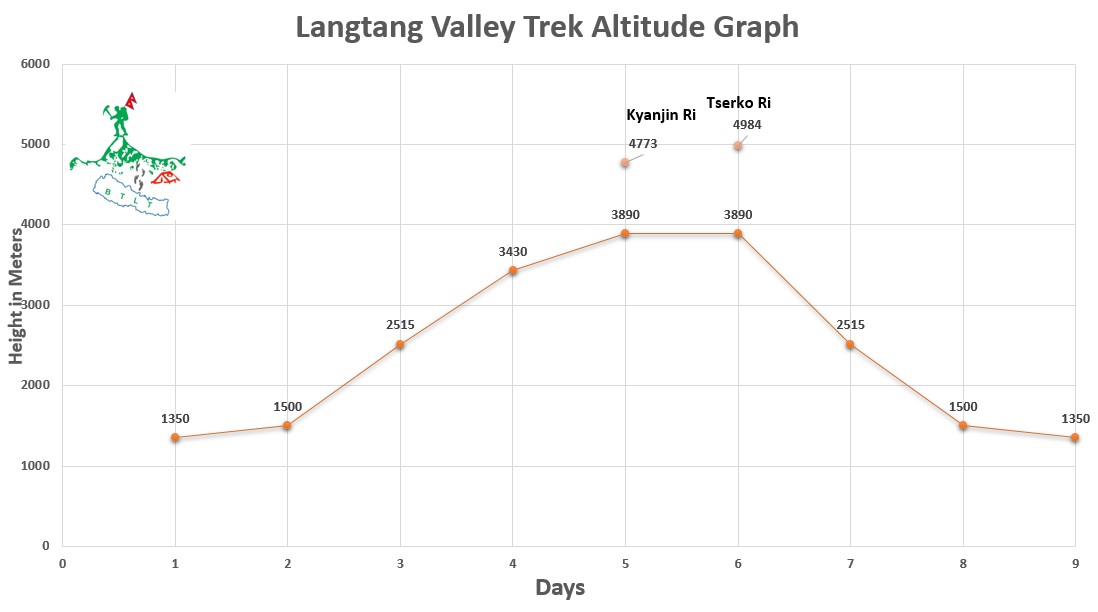
The Langtang Valley Trek has a moderate but important altitude challenge, rising from about 1,460–1,550 meters in Syabrubesi to 3,870 meters at Kyanjin Gompa. That gain of more than 2,300 meters in just a few days is why acclimatization matters so much on this route.
Altitude Profile from Syabrubesi to Kyanjin Gompa
The trek typically begins in Syabrubesi at 1,460–1,550 meters, then climbs to Lama Hotel at around 2,470 meters, Langtang Village at about 3,430 meters, and finally Kyanjin Gompa at 3,870 meters. This steady upward pattern means trekkers feel the change in breathing, energy, and pace more each day. The route is not technically difficult, but the altitude gain is significant enough to require smart pacing.
When Does Altitude Sickness Usually Start
Altitude sickness usually becomes more likely once trekkers go above 2,500 to 3,000 meters, which means the risk starts to increase strongly during the middle and upper parts of the Langtang route. On this trek, symptoms may begin after reaching Lama Hotel, become more noticeable near Langtang Village, and are often most relevant around Kyanjin Gompa. Some trekkers feel fine at first and then develop symptoms after a night of sleep at higher elevation, so problems can appear even if the first day felt easy.
Common Symptoms of Acute Mountain Sickness (AMS)
Common AMS symptoms include headache, nausea, dizziness, poor sleep, fatigue, loss of appetite, and shortness of breath with exertion. These symptoms can feel mild at first, but they should never be ignored because they may worsen if the trekker keeps ascending. A headache combined with unusual tiredness or nausea is especially important to watch for.
How Our Guides Help Prevent Altitude Sickness
Guides help reduce altitude risk by enforcing a slow pace, monitoring trekkers for symptoms, encouraging hydration, and planning sensible rest or acclimatization stops. They also watch for warning signs like unusual breathing difficulty, lack of appetite, or behavior changes, which can signal that a trekker is struggling. In a well-managed trek, guides act early rather than waiting for symptoms to become severe.
Best Acclimatization Tips for a Safe Trek
The most effective acclimatization strategy is to ascend gradually and avoid rushing the itinerary. Drink plenty of water, eat warm carbohydrate-rich meals, avoid alcohol, and rest properly so your body can adapt to the thinner air. A rest or acclimatization day at Kyanjin Gompa is especially valuable because it gives the body time to adjust before any higher side hikes. The “climb high, sleep low” approach is also useful on this trek.
What Happens if a Trekker Develops AMS
If AMS develops, the correct response is to stop ascending immediately and rest at the same altitude or descend if symptoms worsen. Mild symptoms may improve with rest, hydration, and no further climbing, but worsening symptoms require urgent descent and close attention from the guide.
Serious altitude illness should never be pushed through, because continuing upward can turn a manageable problem into a dangerous one.
Practical Trekking Advice
For most trekkers, the Langtang Valley route is safe when the itinerary includes gradual ascent, a sensible pace, and at least one acclimatization-friendly stop. The biggest mistake is moving too fast and assuming fitness alone will protect you from altitude. On this trek, slow walking and good recovery habits are not optional extras; they are part of the safety strategy.
What Is the Langtang Valley Trek Trail Like
The Langtang Valley Trek trail is a mix of lush forest paths, riverside walks, stone staircases, suspension bridges, rocky climbs, and high-altitude glacier terrain near Kyanjin Gompa. It is generally a well-marked Himalayan trail, but the surface and difficulty change a lot as you gain elevation.
Forest Trails and Riverside Paths
The lower part of the route from Syabrubesi moves through subtropical and temperate forest, including rhododendron, pine, and bamboo-covered sections. These early trail segments often follow rivers or run close to the Langtang Khola, which gives the trek a calm, natural feel. In good weather, these paths are among the easiest and most enjoyable parts of the trek.
Stone Staircases and Rocky Sections
As the trail climbs higher, the path becomes steeper, rockier, and more uneven, especially beyond the forested lower valley. Stone staircases and natural rocky stretches require slower, more careful foot placement, particularly when carrying a backpack. These sections are not technical, but they can feel tiring because the ascent is steady and long.
Suspension Bridges Along the Route
Suspension bridges are a regular feature of the Langtang Valley trail, especially in the lower and middle sections where the route crosses rivers and side streams. These bridges are usually safe and well-used, and they add both convenience and a dramatic mountain-trekking feel. For many trekkers, they are a memorable part of the route rather than a major difficulty.
Glacier Moraines Near Kyanjin Gompa
Near Kyanjin Gompa, the scenery changes into a higher alpine landscape with glacial terrain, loose rock, and moraine-style ground. This area feels more exposed, colder, and more rugged than the lower valley, so footing becomes more important. Side hikes from Kyanjin Gompa toward Kyanjin Ri or Tserko Ri are especially demanding because the trail is steeper and the altitude is higher.
Trail Conditions During Spring, Autumn, Monsoon, and Winter
Spring and autumn usually offer the most stable trail conditions, with drier paths and clearer views. During monsoon, the trail can become muddy, slippery, and more landslide-prone, which makes walking harder and less predictable. In winter, snow and ice can make higher sections cold and challenging, especially if you are not well equipped. For most trekkers, the safest and most comfortable seasons are spring and autumn.
Is the Trail Safe During Bad Weather
The trail can still be walked in bad weather, but it becomes significantly riskier when rain, snow, or fog reduce traction and visibility. Lower forest sections may feel slippery, while higher areas can become more exposed to cold, wind, and unstable footing. In monsoon or winter conditions, safety depends heavily on weather checks, guide judgment, proper gear, and the willingness to turn back if conditions worsen.
Common Challenges Trekkers Face on the Langtang Valley Trek (and How We Help)
The Langtang Valley Trek is rewarding but the trekkers often face a few predictable challenges along the way. The good news is that most of them can be managed well with the right pacing, preparation, and on-trail support.
Worried About Altitude Sickness?
Altitude sickness is one of the most common concerns on this trek because the route climbs from roughly 1,460–1,550 meters in Syabrubesi to 3,870 meters at Kyanjin Gompa. Symptoms can begin once trekkers move above about 2,500 to 3,000 meters, especially if they ascend too quickly or skip rest. We help by setting a gradual itinerary, encouraging hydration and rest, monitoring early warning signs, and adjusting the plan before symptoms become serious.
Concerned About Your Fitness Level
Many first-time trekkers worry they are not fit enough, but the Langtang Valley Trek is generally suitable for beginners with basic endurance and preparation. The challenge is less about technical skill and more about walking several hours a day on uphill, downhill, and uneven terrain. We help by recommending a realistic training plan, matching the itinerary to your pace, and keeping walking days manageable rather than rushed.
Unsure What to Pack
Packing mistakes are common on Himalayan treks, especially overpacking or bringing the wrong type of clothing. The Langtang route can feel warm during the day and cold at night, so layering is far more useful than heavy single-purpose clothing. We help by giving a season-specific packing list, advising what can be rented in Kathmandu, and reminding trekkers to keep their bag light and practical.
Afraid of Getting Lost
The trail is fairly well-used, but mountain routes can still feel confusing in fog, rain, or snow, especially in forested sections and around junctions. Poor visibility and trail damage can make navigation harder than expected. We help by providing experienced guides, route awareness, and local knowledge so trekkers stay on the correct path even when conditions change.
What if the Weather Changes Suddenly
Weather in Langtang can shift quickly, especially at higher elevations where rain, wind, or snowfall can appear without much warning. Slippery trails, cold exposure, and reduced visibility can make the trek harder and less safe. We help by checking weather trends, adjusting start times, choosing safer pacing, and making route decisions based on real trail conditions rather than fixed assumptions.
What Happens During a Medical Emergency
A medical issue in the mountains needs fast recognition and calm decision-making, because delays can make problems worse. The most important response is to stop, assess the condition, and descend if necessary, especially for altitude-related illness. We help by keeping guides alert to symptoms, carrying basic first-aid awareness, and coordinating the next steps quickly if evacuation or medical help is needed.
Will Accommodation Be Available
Accommodation in Langtang is usually available in teahouses, but comfort and availability can vary by season and crowd levels. In busy periods, rooms may be basic, and the best lodges can fill up faster than expected. We help by planning ahead, selecting reliable teahouses, and organizing the itinerary so trekkers are not left scrambling for a place to sleep.
Is the Food Safe to Eat
Food on the Langtang trek is generally prepared fresh in teahouses, but trekkers still need to be selective about hygiene, water, and food handling. The safest choices are usually hot, freshly cooked meals and properly treated water. We help by recommending safer meal options, reminding trekkers to avoid risky food habits, and advising on water purification and hygiene.
How Do We Keep You Safe Throughout the Trek
Safety comes from a combination of good pacing, proper acclimatization, weather awareness, route management, and on-trail support. The trek becomes much safer when someone is actively watching for fatigue, altitude symptoms, weather shifts, and logistical issues before they become problems. We help by staying focused on prevention, not just reaction, so trekkers can enjoy the journey with more confidence and less stress.
Is the Langtang Valley Trek Suitable for First-Time Trekkers
Yes, the Langtang Valley Trek is a strong choice for first-time trekkers because it is considered a moderate Himalayan trek and does not require technical climbing skills. The route is manageable for beginners who have basic fitness, can walk several hours a day, and are willing to move slowly at altitude.
Can Beginners Complete the Langtang Valley Trek
Most beginners can complete the Langtang Valley Trek successfully if they prepare properly and choose a sensible itinerary. The trek is often described as beginner-friendly because the trail is well-marked, the daily walking hours are reasonable, and teahouse accommodation makes the logistics simpler. Beginners do not need prior trekking or mountaineering experience, but they do need stamina and patience.
What Challenges Should First-Time Trekkers Expect
First-time trekkers should expect long walking days, uphill and downhill sections, altitude gain, and occasional rough or rocky trail sections. The biggest challenge is often altitude rather than distance, since the trail rises to 3,870 meters at Kyanjin Gompa. Weather, cold nights, and basic mountain accommodation can also feel unfamiliar to people taking their first Himalayan trek.
How Our Guides Support First-Time Trekkers
Our Guides support the first time trekkers by the follow ways :
- Guides keep the pace controlled for first-time trekkers.
- They explain the route clearly.
- They help trekkers adjust to altitude and trail conditions.
- They reduce stress by managing daily logistics.
- They monitor how trekkers are feeling throughout the journey.
- They make the trek feel more structured and safer.
- For beginners, this support can turn a stressful trek into an enjoyable one.
Best Tips for Your First Himalayan Trek
- Train before the trek by walking regularly.
- Climb stairs to build leg strength and stamina.
- Build endurance so 5 to 7 hours of hiking feels realistic.
- Pack light to avoid carrying unnecessary weight.
- Use layers so you can adjust to changing temperatures.
- Bring only the essentials so your bag does not become a burden on the trail.
- Start slowly on the trek.
- Stay hydrated throughout the day.
- Listen to your body and rest when needed.
- Do not rush the ascent, because altitude usually makes a beginner’s trek feel harder.
Is the Langtang Valley Trek Suitable for Kids and Seniors
Yes, the Langtang Valley Trek can be suitable for both kids and seniors, but only when the itinerary is planned carefully and the pace is kept slow. It is not a technical trek, but the altitude, uneven trails, and long walking days still require good preparation and realistic expectations.
Recommended Minimum Age for the Trek
- A practical minimum age is usually around 6 to 8 years old.
- Children below that age may struggle with long walking hours, changing weather, and altitude.
- Age alone is not the only factor; the child’s stamina, maturity, and ability to communicate discomfort matter just as much.
Can Children Safely Complete the Trek
- Yes, many children can complete the trek safely if they are healthy and well supervised.
- The main concerns are fatigue, altitude, cold nights, and dehydration.
- Children should walk at their own pace, take frequent breaks, and avoid carrying heavy bags.
Is the Trek Suitable for Seniors Over 50 or 60
- Yes, many seniors over 50 or 60 can do the trek if they are fit and medically stable.
- Age is less important than overall health, joint strength, lung capacity, and comfort with several hours of walking.
- Seniors with heart, lung, or mobility issues should get medical advice before planning the trek.
Health and Fitness Requirements
- Trekkers should be able to walk 4 to 7 hours a day on uphill and downhill terrain.
- Good stamina and stable knees are important for handling uneven paths.
- Anyone with chronic health conditions should consider how altitude and physical effort may affect them.
Family-Friendly and Private Trek Options
- Private treks are often the best choice for families because the pace can be adjusted easily.
- A family-friendly itinerary allows more rest, shorter walking days, and better support for children or older adults.
- Having a private guide also makes the trek safer and less stressful because the plan can change if someone feels tired or unwell.
How to Physically Prepare for the Langtang Valley Trek
Preparation should start early, ideally 6 to 12 weeks before the trek. The goal is to make long walking days feel manageable before you arrive in the mountains.
When Should You Start Training
- Start training at least 6 to 8 weeks before the trek.
- If you are a beginner, earlier training is even better.
- Gradual preparation is more effective than trying to get fit at the last minute.
Cardio Routine for Better Endurance
- Do brisk walking, jogging, cycling, swimming, or incline treadmill sessions.
- Cardio improves your breathing and helps your body handle long uphill sections.
- Try to increase the duration of your workouts step by step.
Strength and Leg Training Exercises
- Focus on squats, lunges, step-ups, calf raises, and core exercises.
- Strong legs make climbs easier and reduce strain on the knees during descents.
- Core strength helps with balance and carrying a backpack.
Practice Hiking with a Backpack
- Practice hiking with a daypack before the trek.
- This helps your body get used to carrying weight for several hours.
- Start with a light pack and increase it gradually.
Improve Balance and Flexibility
- Add stretching, yoga, or mobility exercises to your routine.
- Better flexibility helps reduce stiffness after long trekking days.
- Balance training is useful on rocky and uneven trails.
Nutrition and Hydration Before the Trek
- Eat balanced meals with enough protein, carbohydrates, fruits, and vegetables.
- Stay hydrated before the trek so your body begins the journey in good condition.
- Avoid overtraining or skipping meals while preparing.
Mental Preparation for Multi-Day Trekking
- Prepare yourself for slow progress, changing weather, and physical tiredness.
- Trekking is not only about fitness; patience and a positive mindset matter a lot.
- Knowing that some days will feel harder than others helps you stay calm and motivated.
Langtang Valley Trek vs Everest Base Camp vs Annapurna Base Camp: Difficulty Comparison
|
Factor
|
Langtang Valley Trek
|
Everest Base Camp Trek
|
Annapurna Base Camp Trek
|
|
Best for beginners
|
Yes, often the best balance of challenge and accessibility for beginners who want a real Himalayan trek.
Itinerary : Langtang Valley Trek
|
Yes for fit, patient beginners, but it is the most demanding of the three because of altitude and longer commitment.
Itinerary : Everest Base Camp Trek
|
Yes, often beginner-friendly and slightly more manageable than EBC because of lower altitude and shorter duration.
Itinerary : Annapurna Base Camp Trek
|
|
Maximum altitude
|
About 3,870 m at Kyanjin Gompa, with side hikes like Tserko Ri going higher.
|
5,364 m at Everest Base Camp.
|
4,130 m at Annapurna Base Camp
|
|
Typical duration
|
About 7 to 10 days
|
About 12 to 14 days
|
About 7 to 11 days
|
|
Daily walking hours
|
Usually 5 to 7 hours per day, depending on the itinerary
|
Long daily hikes are common, and the route is often done over about two weeks
|
Moderate daily hikes, usually a bit shorter and less taxing than EBC
|
|
Trail conditions
|
Forest paths, riverside trails, stone steps, rocky climbs, suspension bridges, and alpine terrain near Kyanjin
|
Well-marked, heavily used mountain trail with significant altitude exposure and long ascents
|
Varied terrain, including village paths, forest, stone steps, and steep sections, but generally less severe than EBC
|
|
Fitness requirement
|
Moderate fitness is enough if you train and pace yourself.
|
Strong fitness and strong altitude tolerance are important
|
Moderate fitness and less altitude pressure than EBC, but still requires stamina.
|
|
Value for experience
|
Excellent value for trekkers who want scenery, culture, and lower cost with fewer crowds.
|
Best for the iconic Everest experience, but usually the most expensive and logistically demanding.
|
Best all-round mix of scenery, comfort, and moderate challenge for many trekkers.
|
Frequently Asked Questions
1. How difficult is the Langtang Valley Trek?
The Langtang Valley Trek is considered moderately difficult, making it suitable for beginners with good fitness as well as experienced trekkers.
2. Is the Langtang Valley Trek suitable for beginners?
Yes. Beginners with basic fitness, proper preparation, and a gradual itinerary can successfully complete the trek.
3. How many hours do you walk each day on the Langtang Valley Trek?
Most trekkers walk between 5 and 7 hours per day, depending on the route, weather, and walking pace.
4. What is the highest altitude of the Langtang Valley Trek?
The standard trek reaches Kyanjin Gompa (3,870 m), while optional hikes to Tserko Ri climb to approximately 4,984 m.
5. Is altitude sickness common on the Langtang Valley Trek?
Altitude sickness can occur once trekkers ascend above 2,500–3,000 meters, but proper acclimatization greatly reduces the risk.
6. What is the hardest part of the Langtang Valley Trek?
The climb to Tserko Ri is generally considered the most physically demanding section because of its steep ascent and high altitude.
7. How fit do you need to be for the Langtang Valley Trek?
Trekkers should comfortably walk 5–7 hours per day on uneven uphill and downhill trails and prepare with cardio and strength training before the trek.
8. Can children complete the Langtang Valley Trek?
Yes. Healthy children, generally 6–8 years or older, can complete the trek when accompanied by adults and following a slower itinerary.
9. Is the Langtang Valley Trek suitable for seniors?
Yes. Many trekkers over 50 or 60 years old complete the trek successfully if they are physically fit and medically prepared.
10. What is the best season for the Langtang Valley Trek?
Spring (March–May) and Autumn (September–November) offer the most stable weather, clearer mountain views, and safer trail conditions.
11. How can I prepare for the Langtang Valley Trek?
Start training 6–12 weeks before departure with cardio exercises, leg-strength workouts, practice hikes, flexibility training, and balanced nutrition.
12. What type of terrain should I expect on the Langtang Valley Trek?
The trail includes forest paths, riverside trails, suspension bridges, stone staircases, rocky climbs, and alpine glacier terrain near Kyanjin Gompa.
13. Can the Langtang Valley Trek itinerary be customized?
Yes. The itinerary can be adjusted to include extra acclimatization days, shorter walking days, or optional hikes based on your fitness and preferences.
14. Is the Langtang Valley Trek harder than Everest Base Camp?
No. Langtang is generally considered easier than the Everest Base Camp Trek because it has a lower maximum altitude, shorter duration, and less demanding logistics.
15. Why should I choose the Langtang Valley Trek over other treks in Nepal?
The Langtang Valley Trek offers stunning Himalayan scenery, rich Tamang culture, moderate difficulty, fewer crowds, shorter duration, and excellent value, making it one of Nepal's best trekking experiences for both beginners and experienced hikers.
Content Reviewed By
Beyond The Limits Treks & Expedition Pvt. Ltd.
A licensed trekking company in Nepal specializing in trekking and adventure travel across the Langtang, Everest, Annapurna, and Manaslu regions. The company's professional team regularly reviews trekking information, route conditions, permit requirements, and travel logistics to ensure content accuracy and reliability.
Legal document: Beyond the limits treks