The Langtang Valley Trek can be done in as few as 5 days or stretched to 12, and the right answer depends on your fitness, time off, and how much altitude buffer you want. If you have limited time and don't mind long walking days, 5–7 days works. If you want a comfortable, low-risk pace with a real acclimatization day, 8–10 days is the sweet spot. If you want to add Gosaikunda's sacred lakes or a Yala Peak climb, plan for 11–12 days.
Looking for a complete trekking package? Explore our Langtang Valley Trek itinerary, pricing, inclusions, and departure dates before choosing the itinerary that suits your travel plans.

Below is a day-by-day breakdown of every common itinerary length, what you gain or give up at each duration, and a straight comparison table to help you pick.
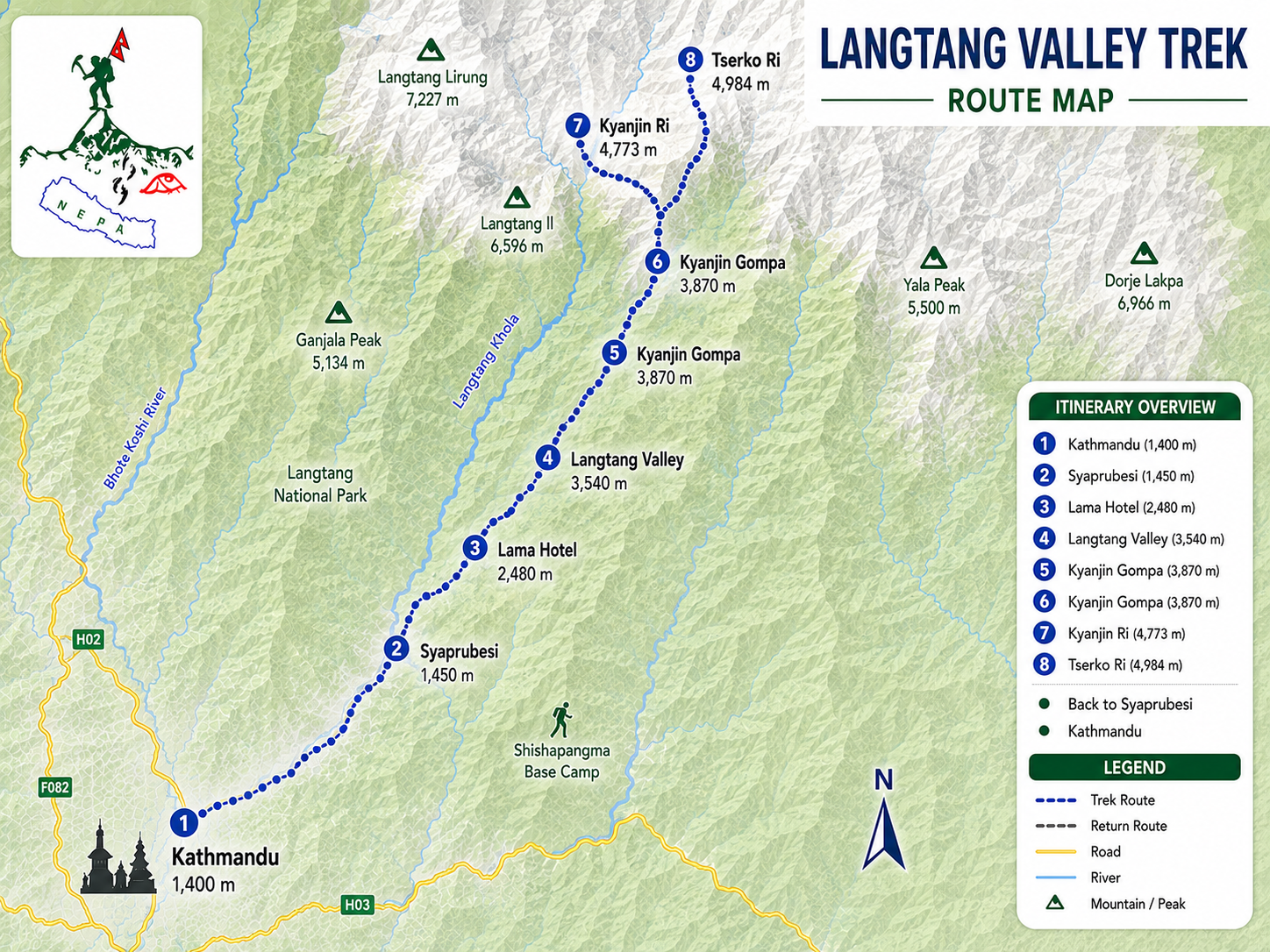
Standard Itinerary Summary
Starting Point: Drive from Kathmandu to Syabrubesi (122 km, approximately 7–8 hours by jeep).
Main Trek Route: Trek follows the Langtang Khola Valley through:
- Lama Hotel
- Langtang Village
- Kyanjin Gompa (3,870 m)
Return Route: Retrace the same trail back to Syabrubesi, then drive back to Kathmandu.
Total Walking Distance: Approximately 60–70 km (round trip).
Total Elevation Gain: Around 2,300 m from Syabrubesi to Kyanjin Gompa.
Route Remains the Same: The 5-day to 12-day itineraries all follow the same main trail.
Difference Between Itineraries: Longer itineraries include:
- Shorter daily hiking distances
- Extra acclimatization day at Kyanjin Gompa
- Additional side hikes and exploration
Popular Side Trips:
- Kyanjin Ri (over 4,700 m)
- Tserko Ri (over 4,700 m)
Longer Trek Advantage: Better acclimatization, a more relaxed pace, and panoramic Himalayan viewpoints.
Langtang Valley Route Map
5-Day Itinerary (Short/Budget Option)
This is the fastest way to reach Kyanjin Gompa and back, built for very fit trekkers who are short on time.
Day 1: Drive Kathmandu to Syabrubesi (1,467 m) and Trek to Bamboo, overnight in Bamboo
Day 2: Trek to Langtang Village (3,430 m) 7-8hours
Day 3: Trek to Kyanjin Gompa (3,870 m), afternoon exploring the monastery and cheese factory
Day 4: Early climb to Kyanjin Ri or Tserko Ri, then descend all the way to Lama Hotel or Rimche, typically an 8–9 hour walking day
Day 5: Trek to Syabrubesi and drive back to Kathmandu
The trade-off: The 5-day version compresses two acclimatization gains into a single long day, most notably Day 4. It's achievable for strong, experienced hikers, but it leaves almost no margin if someone in the group is moving slowly or shows early signs of altitude sickness. We only recommend this option to trekkers who've done high-altitude treks before.
Wondering how much each itinerary costs? Check our detailed Langtang Valley Trek Cost Guide, which explains package prices, permit fees, transportation, and daily expenses.
7-Day Langtang Itinerary
Seven days is the most commonly recommended minimum for a comfortable Langtang trek, because it adds a proper rest day at altitude.
Day 1: Drive Kathmandu to Syabrubesi
Day 2: Trek to Lama Hotel (2,470 m)
Day 3: Trek to Langtang Village (3,430 m)
Day 4: Trek to Kyanjin Gompa (3,870 m)
Day 5: Acclimatization day hike to Kyanjin Ri (4,773 m) or Tserko Ri (4,985 m) and return to Kyanjin Gompa
Day 6: Descend to Lama Hotel
Day 7: Trek to Syabrubesi and drive to Kathmandu
This spreads the ascent over three full days instead of rushing it into two, and it builds in one dedicated high-altitude viewpoint hike with a return to a lower sleeping elevation the core acclimatization principle of "climb high, sleep low." For most moderately fit trekkers, 7 days is the shortest itinerary we'd call genuinely safe rather than just fast.
8-Day Langtang Itinerary
The 8-day itinerary follows the same structure as the 7-day version but breaks up the return leg, which is otherwise the longest walking day of the trek.
Day 1: Arrival in Kathmandu
Day 2: Drive to Shyaprubesi
Day 3: Trek to Lama Hotel
Day 4: Trek to Langtang Village
Day 5: Trek to Kyanjin Gompa
Day 6: Hike to Tserko Ri and back to Kyanjin Gompa
Day 7: Trek to Lama Hotel
Day 8: Trek to Syaprubesi
Day 9: Drive to Kathmandu
Splitting the descent this way removes the single toughest day of the 7-day plan (a 6–7 hour descent squeezed onto the same day as the drive) and replaces it with two relaxed walking days. It's a small change on paper, but it noticeably reduces knee strain and fatigue on the way down, especially for trekkers over 45 or anyone carrying their own pack.
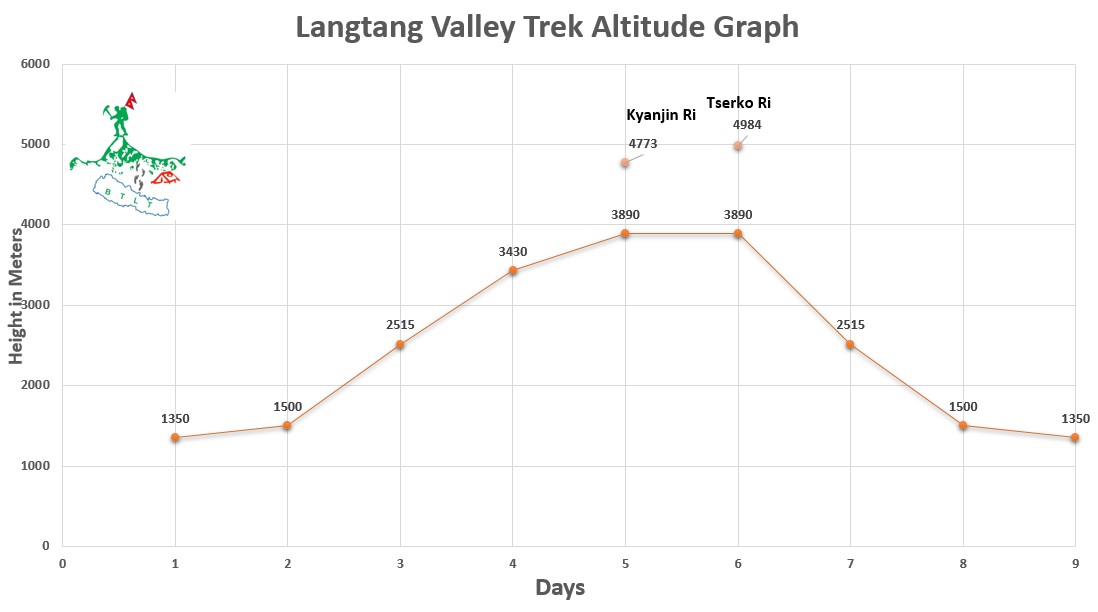
10-Day Itinerary (Our Standard Package)
This is the itinerary we recommend by default, because it adds slack exactly where trekkers most often struggle the ascent.
Day 1: Arrive at Nepal; Transfer to Your Hotel
Day 2: Drive from Kathmandu to Syabrubesi: 7 hours (122km)
Day 3: Trek from Syabrubesi to Lama Hotel (2515m): 6 hrs.
Day 4: Trek from Lama Hotel to Langtang Village (3430m): 6 hrs.
Day 5: Trek from Langtang Village to Kyanjin Gompa (3890): 4 hrs. Hike to Kyanjin Ri: 6 to 7hours
Day 6: Day 06: Hike to Tserko Ri Viewpoint (4984m) and Return to Kyanjin Village
Day 7: Trek from Kyanjin Gompa to Lama Hotel
Day 8: Trek from Lama Hotel to Syabrubesi
Day 9: Drive from Syabrubesi to Kathmandu
Day 10: Departure to International Airport
Most trekking companies recommend the 10-day itinerary because it offers the best balance between acclimatization, comfort, and safety. If you're comparing tour packages and inclusions, see our detailed Langtang Valley Trek package guide.
If you are planning for the 10 days itinerary plan for the Langtang Valley Trek, then this one is perfect for your trekking expereince in the Langtang. You can contact our team to even customized your trip.
Why 10 days beats 7-8 for acclimatization
The extra two to three days aren't padding, they change where your body sits on the altitude curve. On the 7- and 8-day plans, you go from roughly 2,470 m to 3,870 m in two trekking days, which is a fast rate of ascent above 3,000 m by most trekking-medicine guidelines. The 10-day version breaks that same climb into three shorter days, keeps daily gains closer to 400–500 m once you're above 3,000 m, and still gives you a full rest day at Kyanjin Gompa rather than a single side-hike squeezed between arrival and departure.
It also builds in a buffer day. Weather, a late-onset headache, or simply wanting a slower morning at 3,870 m doesn't derail the itinerary. You have room to adjust without cutting a summit hike or missing your flight home. For trekkers without prior high-altitude experience, or anyone trekking with a mixed-fitness group, this is the itinerary length we consistently see produce the fewest turnbacks and the best summit-day experiences at Tserko Ri.
11-12 Day Extended Itinerary (Gosaikunda/Yala Peak)
If you want more than a there-and-back walk to Kyanjin Gompa, an 11- or 12-day itinerary lets you add one of two extensions:
Gosaikunda Lake Trek extension
Instead of retracing your steps to Syabrubesi, you cross the Laurebina Pass (4,610 m) to the sacred alpine lake of Gosaikunda (4,380 m), then descend through Helambu-side villages to a different exit point. This turns the trek from an out-and-back walk into a loop, at the cost of a demanding high pass crossing and a longer overall itinerary most operators run the full Langtang Gosaikunda combination at 12–15 days, but a 12-day version is achievable for fit trekkers who keep the standard Langtang portion tight.
Yala Peak climbing extension:
For trekkers who want to go beyond a viewpoint hike, an extra day or two at Kyanjin Gompa allows a guided ascent of Yala Peak (5,732 m), a non-technical trekking peak popular as an introduction to Himalayan climbing. This requires a climbing permit, a qualified guide, and basic mountaineering gear (crampons, ice axe), which most operators arrange as an add-on rather than a standard package inclusion.
Both extensions share the same logic: they use the acclimatization you've already built up at Kyanjin Gompa (3,870 m) and put it to use, rather than making you descend having only reached a viewpoint.
Comparison Table
|
Itinerary
|
Trekking Days
|
Approx. Distance
|
Max Altitude
|
Best For
|
|
5-Day
|
3 walking days + 2 drive days
|
55–60 km
|
4,773–4,985 m (viewpoint)
|
Very fit, experienced high-altitude trekkers short on time
|
|
7-Day
|
5 walking days + 2 drive days
|
62–65 km
|
4,773–4,985 m
|
Fit trekkers wanting one real acclimatization day
|
|
8-Day
|
6 walking days + 2 drive days
|
65–70 km
|
4,773–4,985 m
|
Trekkers who want an easier descent than the 7-day plan
|
|
10-Day
|
7–8 walking days + 2 drive days
|
65–70 km
|
4,985 m (Tserko Ri)
|
First-time high-altitude trekkers, mixed-fitness groups, our recommended default
|
|
11–12 Day
|
9–10 walking days + 2 drive days
|
75–90 km
|
4,610–5,732 m (Laurebina Pass or Yala Peak)
|
Trekkers adding Gosaikunda's lakes or a Yala Peak climb
|
How to Choose the Right Itinerary
Match the itinerary to what actually constrains you, not just the number that sounds impressive:
- Choose 5–7 days if: you have limited vacation time, you're already acclimatized (recent time at altitude elsewhere), and everyone in your group is a strong, experienced trekker.
- Choose 8 days if: you want the standard route but with a gentler descent and less risk of knee strain or fatigue on the way down.
- Choose 10 days if: This is your first time above 3,500 m, you're trekking with people of different fitness levels, or you simply want a comfortable margin for weather, rest, and a proper acclimatization day. This is what we book for the great majority of clients.
- Choose 11–12 days if: Kyanjin Gompa alone isn't enough and you want Gosaikunda's high pass and sacred lakes, or a guided ascent of Yala Peak, added to the same trip.
If you're unsure, it's easier to plan a longer itinerary and finish early than to plan a short one and run out of days when you need an extra acclimatization stop.
Content Reviewed By
Beyond The Limits Treks & Expedition Pvt. Ltd.
A licensed trekking company in Nepal specializing in trekking and adventure travel across the Langtang, Everest, Annapurna, and Manaslu regions. The company's professional team regularly reviews trekking information, route conditions, permit requirements, and travel logistics to ensure content accuracy and reliability.
Legal document: Beyond the limits treks

Frequently Asked Questions
1. What is the minimum number of days needed for the Langtang Valley Trek?
Five days is possible for very fit, experienced trekkers, but 7 days is the shortest itinerary most guides consider genuinely safe, since it includes one acclimatization day at Kyanjin Gompa.
2. Is 10 days enough for Langtang Valley?
Yes, 10 days is more than enough for the standard Langtang Valley Trek and is our recommended length. It covers the full route to Kyanjin Gompa, a rest/acclimatization day, at least one side hike, and a comfortable multi-day descent.
3. Do I need extra permits for the 11–12 day Gosaikunda or Yala Peak extensions?
The standard Langtang Valley Trek requires a Langtang National Park entry permit and a TIMS card. Adding Gosaikunda doesn't require an additional permit, but Yala Peak requires a separate climbing permit arranged in advance through a registered agency.
4. What's the highest point on each itinerary?
On the standard 5–10 day itineraries, the highest point is Tserko Ri (around 4,985 m) or Kyanjin Ri (4,773 m), both day hikes from Kyanjin Gompa. The 11–12 day extensions reach higher still: the Laurebina Pass at 4,610 m or the summit of Yala Peak at 5,732 m.
5. Can I shorten or lengthen these itineraries once I arrive?
To some extent, yes most teahouse routes allow flexibility to add a rest day or skip a side hike. But the drive days, permits, and any pre-booked Yala Peak climbing arrangements are easier to plan correctly before you leave than to rearrange on the trail.
6. Is one acclimatization day enough for the Langtang Valley Trek?
Yes. One acclimatization day at Kyanjin Gompa is sufficient for most trekkers following a 7-day or longer itinerary, helping reduce the risk of altitude sickness.
7. Can I combine the Langtang Valley Trek with Gosaikunda Lake?
Yes. The trek can be extended into an 11–12 day itinerary by crossing Laurebina Pass and visiting the sacred Gosaikunda Lake, making it a rewarding loop trek.
8. Is the Yala Peak extension worth adding to the Langtang Valley Trek?
Yes. If you want a more adventurous experience, you can extend your trek to Yala Peak (5,732 m) with a licensed guide and proper climbing equipment.
9. Which Langtang Valley Trek itinerary is best for first-time trekkers?
The 10-day itinerary is the best choice for beginners because it offers gradual acclimatization, a comfortable pace, and extra flexibility for weather and altitude.
10. How do I choose between the 7-day, 8-day, and 10-day Langtang Valley Trek itineraries?
Choose 7 days if you're fit and short on time, 8 days for a more relaxed descent, and 10 days for the safest and most comfortable trekking experience.